Section H
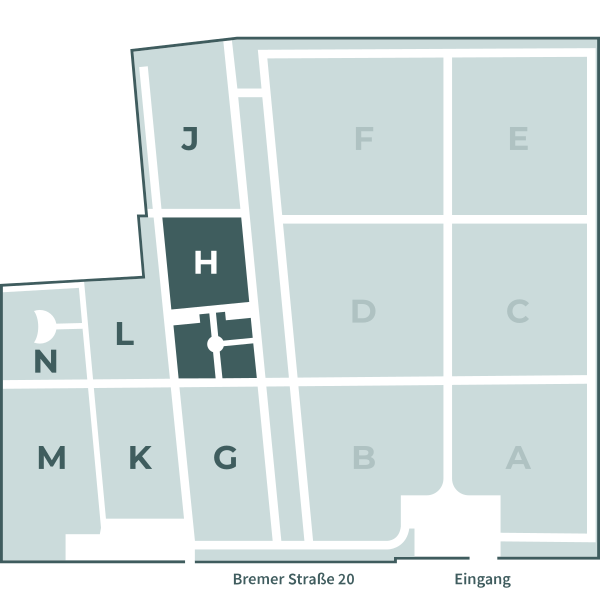
Around 90 victims of war and state repression are buried in Section H. It consists of two subsections separated by a path. About one third of those buried here were Wehrmacht soldiers, German prisoners of war who had been released, and members of the Schutzpolizei (the uniformed branch of the Ordnungspolizei). Around twenty were civilians killed in air raids; six civilian forced labourers were also buried here.

Burials in Section H
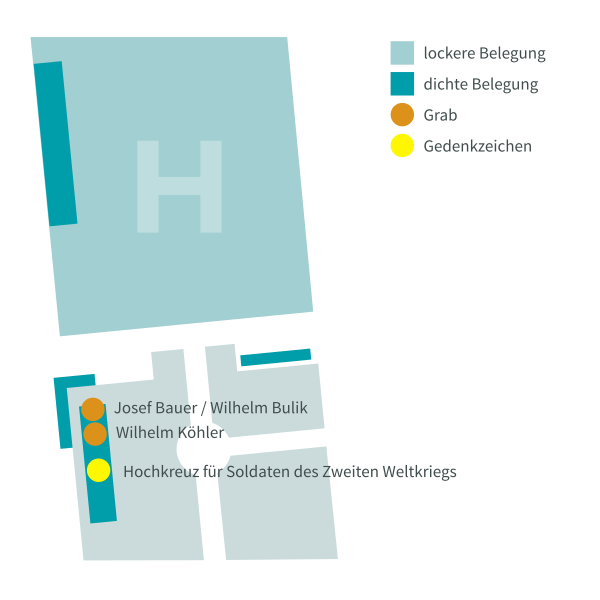
Between April 1942 and early 1946, burials took place in the southern part of the section, where the graves were laid out closely together around a large memorial cross. The Wehrmacht soldiers had died of their injuries in military reserve hospitals in or around Dresden, or in other hospitals in the city. The German soldiers released from prisoner-of-war captivity came from formerly German territories in the Sudetenland, Silesia and East Prussia. Of the five police officers buried here, two were killed in the air raid on Dresden on 17 April 1945.
In June 1944, the cemetery administration had six male civilian forced labourers buried at sites beside the paths in the northern part of the section, an area no longer used for burials. They had died as a result of workplace accidents or infectious diseases.
Around 1940: Memorial grove for soldiers of the Second World War
The large memorial cross bears the Latin inscription INRI (Iesus Nazarenus Rex Iudaeorum, meaning ‘Jesus of Nazareth, King of the Jews’), which has formed part of depictions of the Crucifixion in Christian iconography since the fourth century. A stone wall and hedge enclose this part of the section. Symmetrically laid paths run through it, and a flight of steps leads into the area with the memorial cross directly in view. The memorial area was created after the outbreak of the Second World War to honour deceased members of the Wehrmacht. Its purpose is reflected in terms used in the burial registers, including ‘war grave’, ‘soldier’s grave’, ‘heroes’ cemetery’, ‘war-graves section’, ‘memorial grove’ and ‘soldiers’ cemetery’. The cemetery administration appears to have followed plans of the Nazi regime to bury Wehrmacht soldiers together in ‘war cemeteries’ or in separate ‘fields of honour’ within cemeteries.
From January 1945 onwards, the cemetery administration buried a total of 21 German civilians killed in air raids outside the walled enclosure, on the northern side near the large memorial cross. They had died in bombing raids on Dresden and Pirna between October 1944 and April 1945. For those killed in the raids of 7 October 1944 and 16 January 1945, the City of Dresden had established a collection point for the war dead at the Äußerer Matthäusfriedhof because it lay close to the affected districts; most of the dead were also buried there. It is possible that civilians later buried at the Neuer Katholischer Friedhof were first taken there, identified, and then transferred to the neighbouring Catholic cemetery because they were Catholic. Those killed on 16 January 1945 included Anna Melzer and her two children. In the immediate post-war period, a number of German expellees were also buried here over a short period. Almost fifty people were buried here in all, including three female civilian employees of the Wehrmacht. They were probably deliberately buried near the soldiers’ graves as the ‘fallen’ of the ‘home front’.


Section H in the Soviet Occupation Zone and the GDR
Between October 1945 and January 1946, sixteen prisoners of war who had been released were buried in the memorial burial area for Wehrmacht soldiers. Today, only two adjacent graves of former prisoners of war remain clearly visible: the joint grave of Josef Bauer and Wilhelm Bulik, and the grave of Wilhelm Köhler. The cemetery administration levelled graves of Wehrmacht soldiers that were no longer being cared for by relatives and reused the burial plots.
Section H after 1989/90
Together with Section K, which had likewise received little attention during the GDR period, Section H again attracted attention after 1989/90 as a ‘soldiers’ burial section’. In early 1992, the Volksbund Deutsche Kriegsgräberfürsorge (German War Graves Commission) concluded that the original layout of the military burial area could no longer be reconstructed, as only a few visible graves survived and some of these were civilian graves. Part of the section was nevertheless granted permanent protection as a collective burial site under the Graves Act.
The graves of more than twenty other soldiers, buried at different locations in other cemetery sections, no longer survive either. Most were soldiers of the First World War who died of their wounds in military hospitals or later from their effects. One of the two flat memorial slabs in Section H commemorates this group.
